The Best Books on Emotional Regulation: A Curated Library for Inner Balance

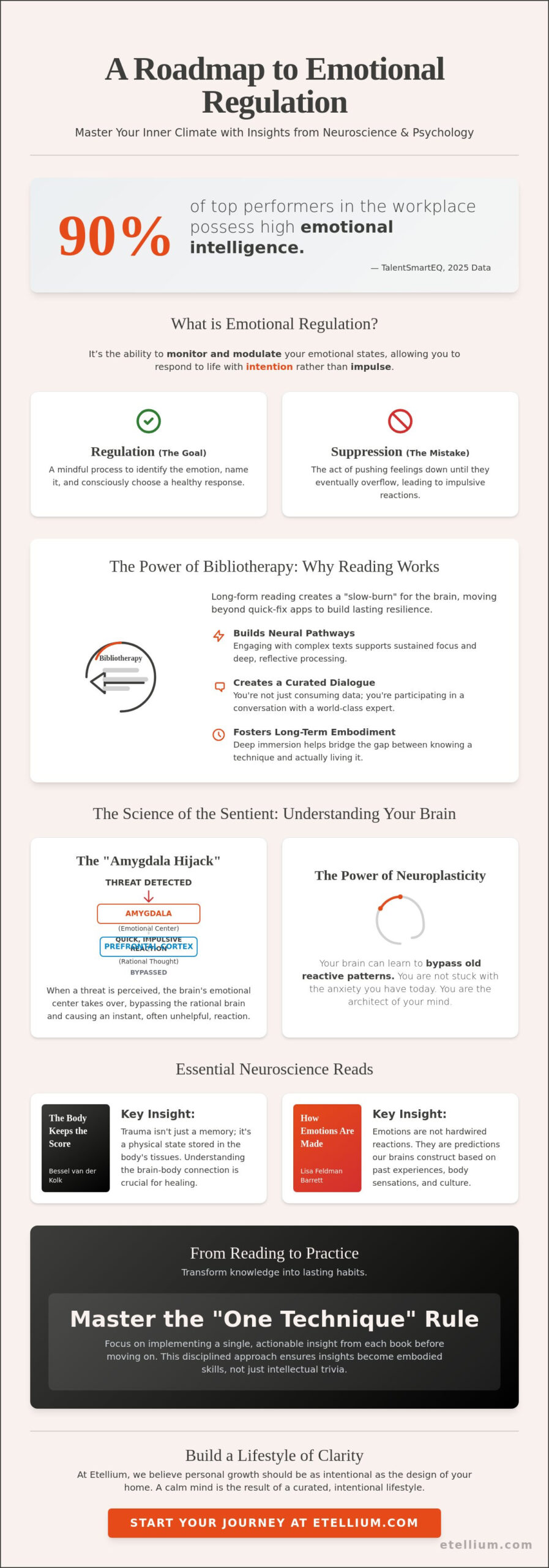
Did you know that 90% of top performers in the workplace possess high emotional intelligence, according to 2025 data from TalentSmartEQ? It’s a striking figure that underscores why so many of us feel frustrated when we’re hijacked by intense emotions or drained by chronic stress. If you’ve been searching for the best books on emotional regulation, you’ve likely encountered a confusing mix of CBT, DBT, and mindfulness frameworks. It’s a common struggle, and you aren’t alone in wanting a clearer path to mental clarity.
This article provides a structured roadmap through the most impactful literature in the field, offering a curated selection backed by neuroscience and practical psychology. You’ll discover actionable techniques from world-class experts that transform abstract concepts into daily habits. We will preview a reading list designed to help you reclaim agency over your mental health and build a sense of lasting inner balance. For those seeking a guided experience, our Emotional Intelligence Mastery eBook offers a comprehensive framework to complement the insights found in these titles. Let’s begin building your personal library for a more intentional and balanced life.
Key Takeaways
- Understand how bibliotherapy serves as an elegant method for monitoring and modulating your emotional states through curated reading.
- Examine the neuroscience of the sentient brain with essential books on emotional regulation that bridge the gap between physical health and mental clarity.
- Identify whether CBT or DBT offers the most effective cognitive framework for your unique journey toward inner balance.
- Learn to apply emotional intelligence in professional and personal contexts to foster resilience and a greater sense of agency.
- Master the “One Technique” rule to ensure that the insights from your library become actionable habits for long-term mental fitness.
Understanding Emotional Regulation: Why Bibliotherapy Works
Mastering your internal climate isn’t about rigid control; it’s about thoughtful cultivation. At its core, emotional self-regulation is the sophisticated ability to monitor and modulate your emotional states as they arise. It allows you to respond to life’s variables with intention rather than impulse. While many seek immediate relief through digital apps, there’s a profound, lasting power in the practice of bibliotherapy. This concept involves using literature to improve mental health, encouraging a deep, reflective processing that quick-fix notifications simply cannot replicate. It’s a slower, more deliberate path to wellness.
Long-form reading creates a slow-burn for the brain. It builds neural pathways that support sustained focus. This is essential for anyone researching the best books on emotional regulation. When you engage with a physical book, you aren’t just consuming data; you’re participating in a curated dialogue with an expert. This deep immersion helps bridge the gap between knowing a technique and actually embodying it. A calm mind is rarely an accident. It’s the result of a curated, intentional lifestyle where the information you consume is as high-quality as the objects you keep in your home.
The Core Components of Emotional Intelligence
Self-awareness is the bedrock of all personal growth. Without it, you’re a passenger to your own moods. Many people confuse regulation with suppression, which is the act of pushing feelings down until they eventually overflow. True regulation involves identifying the emotion, naming it, and choosing a healthy response. Detailed literature provides the precise vocabulary needed to describe these complex internal states. If your internal vocabulary is limited to “good” or “bad,” your ability to navigate stress is restricted. Books on emotional regulation introduce nuances like “languishing” or “resilience,” allowing you to pinpoint your experience with surgical precision.
The Etellium Approach to Personal Growth
At Etellium, we believe that personal growth should be as intentional as the furniture in your home. We prioritize quality, expert-vetted resources that stand the test of time, moving away from the noise of viral social media trends. A calm mind is often the result of a curated environment. Creating a dedicated sanctuary for growth is a vital step. Whether you’re settling into a modern minimalist sectional sofa or a quiet corner of your study, the physical space you inhabit influences your capacity for deep work. Our approach blends this aesthetic mindfulness with practical tools, such as our Emotional Intelligence Mastery eBook, to help you build a lifestyle rooted in clarity and quiet confidence.
The Science of the Sentient: Essential Neuroscience Reads
Understanding the biological mechanics of your feelings is the first step toward true mastery. If you want to move beyond surface-level advice, you must look at the neuroscience. Many books on emotional regulation focus on behavior, but the most impactful ones start with the brain. Bessel van der Kolk’s The Body Keeps the Score remains a cornerstone in this field. It explains how trauma isn’t just a memory; it’s a physical state stored in the tissues. For a modern perspective, Lisa Feldman Barrett’s How Emotions Are Made is essential. She challenges the outdated “triune brain” theory, arguing that emotions are predictions our brains make based on past experiences. This shifts the focus from being a victim of your biology to being its architect.
We’ve all felt that sudden surge of heat or the urge to snap. This is the “Amygdala Hijack.” When the brain perceives a threat, the emotional center takes over, bypassing the rational prefrontal cortex. Recognizing this process as it happens is vital. Marc Brackett, Ph.D., emphasizes that we need Permission to Feel before we can regulate. Validating the physical reality of an emotion is a prerequisite for moving through it. Thanks to neuroplasticity, your brain can actually learn to bypass these old reactive patterns. You aren’t stuck with the temper or the anxiety you have today.
Decoding the Brain-Body Connection
The Vagus nerve acts as a highway between the brain and heart. Peter Levine’s Waking the Tiger explores how physical sensations are the “early warning system” for our feelings. If you can feel the tension in your shoulders before you feel the anger, you’ve gained a strategic advantage. It’s about listening to the body’s subtle cues before they become a roar. This somatic awareness is a key tool for anyone looking to deepen their emotional intelligence.
Mastering Your Nervous System
Mastering your nervous system is a skill that requires the right books on emotional regulation to guide you. Use the “Window of Tolerance” framework to assess your state. Are you hyper-aroused, feeling anxious and angry, or hypo-aroused, feeling numb and shut down? Deb Dana’s The Polyvagal Theory in Therapy makes these complex ideas accessible for everyday life. Learning where you sit on this spectrum allows you to choose the right tool for the moment. A calm nervous system is best supported by a serene environment, such as a quiet room with a modern minimalist sectional sofa designed for reflection. Our Emotional Intelligence Mastery eBook further explores these frameworks to help you build lasting resilience.
Practical Toolkits: Cognitive and Behavioral Frameworks
Understanding the brain’s mechanics provides a vital foundation, but the true work of transformation happens in the daily application of skills. When you search for the most effective books on emotional regulation, you’ll eventually encounter two primary frameworks: Cognitive Behavioral Therapy (CBT) and Dialectical Behavior Therapy (DBT). These aren’t just clinical acronyms; they are practical toolkits designed to help you dismantle negative thought patterns and navigate emotional storms with quiet confidence. While neuroscience explains the “why,” these frameworks provide the “how.”
David Burns’ Feeling Good remains a landmark text for anyone struggling with persistent negative thought loops. It introduces readers to the idea that our emotions are often a direct reflection of our internal dialogue. If that dialogue is distorted, our emotional state will follow. For those who feel their emotions are too intense for logic alone, The Dialectical Behavior Therapy Skills Workbook offers a hands-on alternative. It provides immediate, actionable exercises to ground yourself when feelings become overwhelming. Choosing between these approaches depends on whether you need to challenge your thoughts or manage your physiological intensity.
CBT Essentials for Daily Thought Management
CBT operates on the “Thought-Feeling-Action” triangle. This model suggests that by changing one corner of the triangle, you can influence the others. A core skill involves identifying “Cognitive Distortions,” which are essentially logical fallacies or lies your brain tells you under stress. For instance, “catastrophizing” turns a minor setback into a total failure. Mind Over Mood by Greenberger and Padesky is an excellent resource for this. It uses structured worksheets to help you pause, evaluate your thoughts, and choose a more balanced perspective. This practice turns reactive habits into intentional choices.
DBT for Emotional Resilience and Crisis
For high-intensity emotional swings, DBT provides a more robust structure. It rests on four essential pillars:
- Mindfulness: Staying present in the current moment without judgment.
- Distress Tolerance: Learning to survive an emotional crisis without making it worse.
- Emotion Regulation: Reducing your vulnerability to “emotional hijacks.”
- Interpersonal Effectiveness: Maintaining relationships while standing your ground.
A game-changing concept within this framework is “Radical Acceptance,” the practice of accepting reality as it is, even when it’s painful. Marsha Linehan’s Building a Life Worth Living offers a deeply personal look at how these skills were developed. To bridge these behavioral approaches with a more flexible, modern mindset, Susan David’s Emotional Agility is an invaluable guide. It teaches you how to “unhook” from difficult emotions so they no longer dictate your actions. If you’re looking for a structured summary of these diverse techniques, our Emotional Intelligence Mastery eBook serves as a curated guide to help you implement these frameworks into a lifestyle of inner balance.
Contextual Mastery: Regulation in Work, Parenting, and Life
Moving from the laboratory to the living room requires a shift in perspective. While neuroscience provides the map, contextual mastery is the journey itself. It’s one thing to understand the amygdala in a quiet study; it’s quite another to manage a “hijack” during a high-stakes board meeting or a toddler’s meltdown. The most effective books on emotional regulation are those that bridge this gap, offering strategies that survive the friction of real-world application. Mastery in this area doesn’t mean the absence of emotion. It means having the presence of mind to choose your response in the heat of the moment.
Daniel Goleman’s Emotional Intelligence remains the definitive guide for the modern professional. According to 2026 data from CareerBuilder, 71% of employers now value Emotional Quotient (EQ) over IQ. This isn’t a soft preference. It’s a recognition that technical skills are secondary to the ability to manage stress and collaborate effectively. Marc Brackett’s Permission to Feel takes this further by advocating for an institutional approach. He argues that schools and workplaces must become “emotionally intelligent” environments where feelings are valid data points rather than distractions. This shift is essential for anyone looking to foster a culture of resilience and psychological safety.
Parenting often serves as the ultimate mirror for our own regulation skills. Your children don’t just listen to your instructions; they absorb your internal state. If you are dysregulated, they will likely follow suit. Learning to regulate yourself is the first step in co-regulating with them. When searching for books on emotional regulation, look for titles that emphasize this “inside-out” approach. It’s about cultivating a calm interior that your family can lean on during turbulent times.
Emotional Intelligence in Professional Leadership
Senior roles demand more than technical expertise. High EQ is often the missing link between a talented manager and a truly visionary leader. Research from 2026 indicates that employees with high EQ earn an average of $5,600 more per year. In Primal Leadership, Goleman and his colleagues explore “Emotional Contagion.” This is the phenomenon where a leader’s mood sets the emotional tone for the entire team. A regulated leader creates a stabilizing force that allows for innovation even under pressure.
Mindfulness and Daily Resilience
Resilience isn’t a modern invention. It’s a practice that dates back to the Stoics. A modern translation of Marcus Aurelius’ Meditations offers timeless wisdom on emotional regulation. He reminds us that while we cannot control external events, we can control our judgment of them. This creates the essential “gap” between a stimulus and your response. Mindfulness helps you inhabit that gap, giving you the agency to choose your path forward. To build these skills into your daily routine, you can explore our Emotional Intelligence Mastery eBook for a structured approach to inner balance.
Curating Your Personal Growth Library: From Reading to Practice
Acquiring knowledge is a sophisticated first step, but true transformation requires a move from passive consumption to active implementation. Reading about inner balance is a start. Embodying it is the finish line. When you engage with books on emotional regulation, treat them as living documents rather than static texts. This shift in perspective turns a library into a laboratory for your personal evolution. Mastery is not found in the number of pages you turn; it is found in the techniques you actually use when life becomes demanding.
Active reading is the most effective way to ensure these concepts take root. Use a dedicated journal to record your reactions and keep a pen ready for marginalia. Writing in the margins turns a book into a dialogue between your current self and the person you are becoming. To avoid information overload, apply the “One Technique” rule. Pick exactly one tool from every book you finish. Practice it for 30 days before moving to the next. This deliberate pace ensures that your reading leads to genuine behavioral change rather than just intellectual curiosity.
Your physical environment plays a silent but significant role in this process. Deep psychological work requires a sanctuary free from distractions and clutter. A clean, intentional space mirrors a clear, intentional mind. Consider the air you breathe as part of this curation. Utilizing a Smart HEPA Air Purifier can ensure your reading nook remains fresh, helping you maintain the focus needed for difficult self-reflection. Digital resources also serve as a modern bridge to maintain momentum between your deep reading sessions.
How to Read for Behavioral Change
Success in self-regulation is rarely accidental. It requires a methodical approach to how you select and process information. Follow these three steps to maximize your growth:
- Step 1: Audit your current emotional triggers. Identify the specific situations where you feel most “hijacked.”
- Step 2: Select a book that targets that specific pain point. Don’t read what’s popular; read what you need.
- Step 3: Schedule 20 minutes of “Deep Work” reading daily. Do this in a dedicated space with no digital interruptions.
The Etellium Choice for Emotional Mastery
At Etellium, we understand that your time is your most valuable asset. While the books on emotional regulation we’ve discussed are foundational, we have developed a streamlined synthesis for the modern consumer. Our proprietary Emotional Intelligence Mastery eBook bridges the gap between complex scientific theory and the practical needs of a high-performance lifestyle. It offers a curated path to clarity without the dense jargon of clinical manuals. It is designed for those who value both high standards of production and actionable expertise. Elevate your EQ with the Emotional Intelligence Mastery eBook and begin your journey toward a more balanced and intentional life today.
Embracing the Path to Emotional Mastery
Building a curated library is more than an intellectual exercise; it’s a commitment to your long-term mental fitness. By exploring the best books on emotional regulation, you’ve gained a map that spans from the biological roots of the nervous system to the practical applications of CBT and DBT. You now understand that true balance comes from bridging the gap between scientific theory and intentional daily practice. Whether you’re leading a team or navigating the complexities of home life, your ability to remain centered is your greatest asset.
If you’re ready to move beyond the shelf and into action, we’ve designed a resource specifically for the modern high achiever. Our expertly curated digital resources provide a streamlined synthesis of these powerful concepts. With secure shopping and immediate download, you can start your transformation without delay. Master your emotions today with the Emotional Intelligence Mastery eBook. You possess the agency to rewrite your emotional responses. We’re here to provide the tools for that journey.
Frequently Asked Questions
What is the best book on emotional regulation for beginners?
Daniel Goleman’s “Emotional Intelligence” is widely considered the best starting point for those new to the field. It provides a comprehensive overview of how emotions influence our lives and why they matter more than IQ. If you prefer a more modern and personal approach, Marc Brackett’s “Permission to Feel” offers a gentle entry into identifying and validating your internal states. Both serve as excellent foundational books on emotional regulation.
Can reading books really help me control my anger or anxiety?
Reading serves as a form of bibliotherapy that provides the cognitive tools necessary to reframe your internal narrative. While a book alone won’t vanish anxiety, it equips you with a “vocabulary” for your feelings. By naming an emotion, you reduce its power. This intellectual distance allows you to choose a response rather than reacting impulsively to anger or stress. It’s about building a mental toolkit for real-world application.
What is the difference between CBT and DBT books?
CBT books focus on the logic of your thoughts, helping you identify and challenge distortions like catastrophizing. They are ideal for managing persistent negative thinking. In contrast, DBT books are designed for high-intensity emotional swings. They emphasize distress tolerance and “Radical Acceptance.” While CBT asks you to change your thoughts, DBT provides skills to survive the emotional storm when logic feels out of reach.
Are there books on emotional regulation specifically for men?
Most high-quality resources are universal, but some authors address the specific social conditioning men often face regarding emotional expression. Terrence Real’s “I Don’t Want to Talk About It” is a significant work that explores male depression and regulation. For a more modern, leadership-focused perspective, Goleman’s works are excellent for navigating professional environments where traditional “stoicism” is often expected but can lead to burnout.
How do I choose between a science-heavy book and a practical workbook?
Your choice depends on whether you need to understand the “why” or the “how.” If you feel confused by your reactions, a science-heavy book like “The Body Keeps the Score” explains the biological roots. However, if you already understand your triggers but lack the tools to stop them, a practical workbook is better. Many readers find success by pairing a theoretical text with a hands-on guide to bridge the gap between theory and action.
What is the ‘amygdala hijack’ and which book explains it best?
The “amygdala hijack” occurs when your brain’s emotional center perceives a threat and shuts down your rational prefrontal cortex. This leads to impulsive, often regrettable reactions. Daniel Goleman explains this concept most famously in “Emotional Intelligence.” Understanding this biological bypass is a crucial step in learning to pause. It helps you recognize the physical surge before the emotional outburst takes over your decision-making.
Is Marcus Aurelius’ Meditations relevant for modern emotional regulation?
Marcus Aurelius’ “Meditations” remains profoundly relevant because it is the philosophical ancestor of modern Cognitive Behavioral Therapy. Stoicism teaches that we aren’t disturbed by events, but by our opinions about them. This ancient wisdom provides a timeless framework for maintaining inner balance amidst external chaos. A modern translation can serve as a daily guide for anyone seeking a more resilient and intentional lifestyle.
How long does it take to see results from practicing the techniques in these books?
You may feel a sense of relief immediately after gaining a new perspective, but lasting behavioral change typically takes 30 to 60 days of consistent practice. Emotional regulation is a skill, not a switch. By applying the “One Technique” rule mentioned earlier, you’ll notice subtle shifts in your reactivity within a few weeks. The goal is progress as you integrate these books on emotional regulation into your life.













Leave a comment