-
Shop
- Adidas
- Advanced Technologies
- AI Skills Mastery 2026 Collection
- Behavior & Emotions
- Best-Sellers
- Budget, Small-Space & DIY
- Car Accessories
- Daily Routines & Care
- Dating & Social Skills
- Digital Resources
- Education & Learning
- Emotional Intelligence
- Everyday Tech Guides
- Family & Lifestyle Tech
- Family & Parenting
- Fashion
- Alexander McQueen
- Bags
- Bags & Wallets
- Balenciaga
- Belts
- Blazers
- Bottega Veneta
- Brunello Cucinelli
- Burberry
- Chanel
- Chloé
- Dior
- Dolce & Gabbana
- Dresses
- Etro
- Fendi
- Gucci
- Hats & Hair Accessories
- Jewelry
- Jil Sander
- Keychains
- Kiton
- Luggage
- Miu Miu
- Off-White
- Outerwear
- Prada
- Rick Owens
- Saint Laurent
- Shoes
- Socks & Tights
- Sunglasses
- The Row
- Tom Ford
- Valentino
- Valentino Garavani
- Versace
- Vivienne Westwood
- Watches
- Feeding & Nutrition
- Furniture
- Gadgets
- Health & Beauty
- Health & Wellness
- Home & Garden
- Home Styling & Organization
- Home Supplies
- Household Cleaning Guides
- Kids & Babies
- Kitchen
- Kitchen & Cooking
- Lighting
- Makeovers & Layouts
- Nike
- Nutrition & Hydration
- Parenting & Family Life
- Patio, Lawn & Garden
- Personal Growth
- Pet Care
- Pet Supplies
- Pets
- Productivity
- Safety & Health
- Sleep & Bedtime
- Smart Homes & Daily Tech Use
- Smartphones & Mobile Devices
- Sport & Outdoors
- Style & Atmosphere
- Training & Enrichment
- Travel
- Wealth
- Popular
- Best deals
Choosing Furniture That Lasts: The Ultimate Quality Inspection Guide (2026)
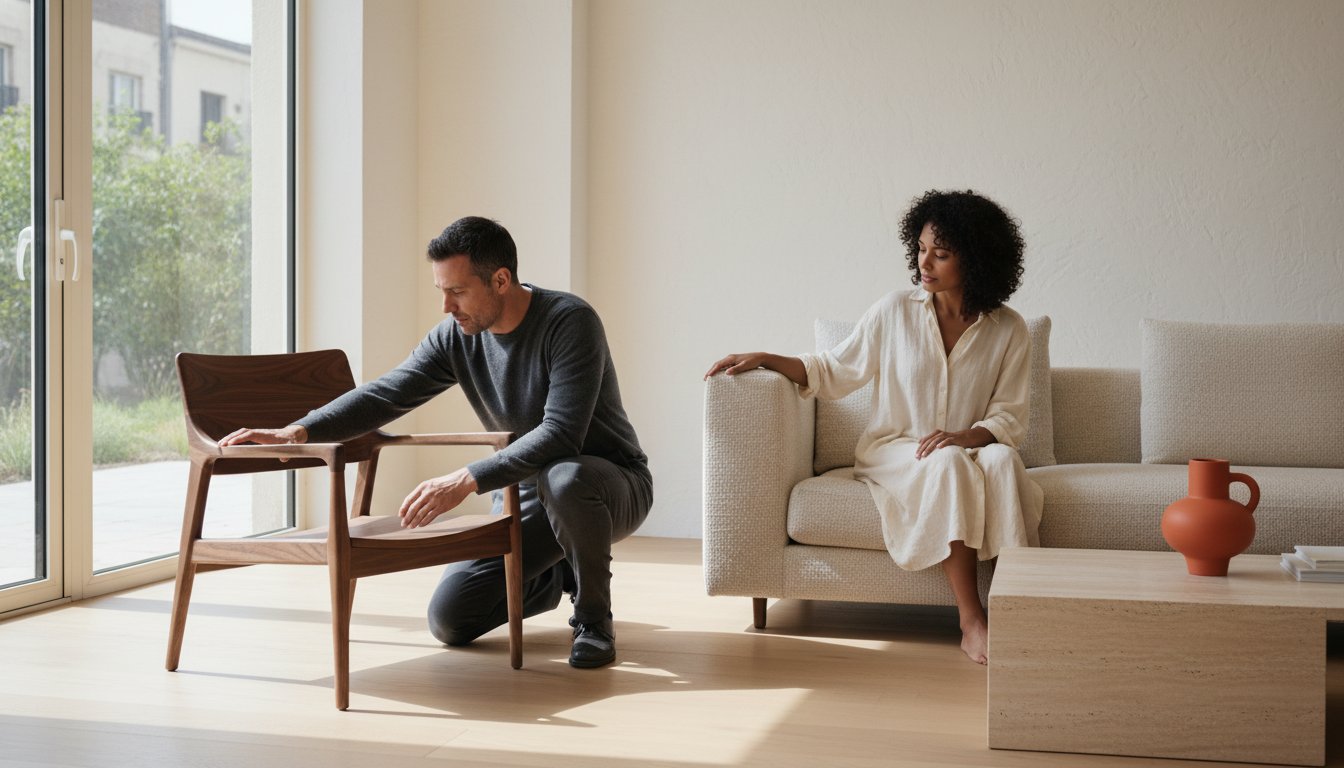
What if the most expensive sofa in the showroom is actually designed to fail in three years? It’s a common frustration for many homeowners who find their “investment” pieces pilling, sagging, or showing signs of wear far too soon. You likely believe that a beautiful home should be built on a foundation of items that endure, yet the current market makes choosing furniture that lasts feel like a difficult gamble. With new 2026 fire safety regulations and ongoing upholstery tariffs shifting the manufacturing landscape, the importance of making an informed, high-quality selection has never been more vital.
You deserve the confidence to distinguish between a thin veneer and solid craftsmanship before you ever make a purchase. We’ll provide you with a clear framework for evaluating the “invisible architecture” of your next piece, from the density of the frame to the specific markers of expert joinery. This guide offers a step-by-step inspection process to help you identify true quality and lower your cost-per-year of ownership. We’ll explore the tactile signs of durability and the technical standards that separate temporary trends from pieces that will serve your family for decades.
Key Takeaways
- Identify the structural essentials of quality craftsmanship by distinguishing between kiln-dried hardwoods and inferior green lumber.
- Master the technical markers of choosing furniture that lasts, focusing on superior joinery techniques like mortise and tenon that ensure long-term stability.
- Decode upholstery durability through professional metrics like the Martindale Rub Count and foam density to prevent early sagging and fabric wear.
- Apply practical on-site evaluation methods, including the Lift and Squeeze tests, to verify material density and frame padding before you buy.
- Shift your purchasing strategy toward a cost-per-use model that prioritizes environmental sustainability and the enduring value of well-made pieces.
Beyond the Aesthetic: Why Longevity is the Ultimate Luxury
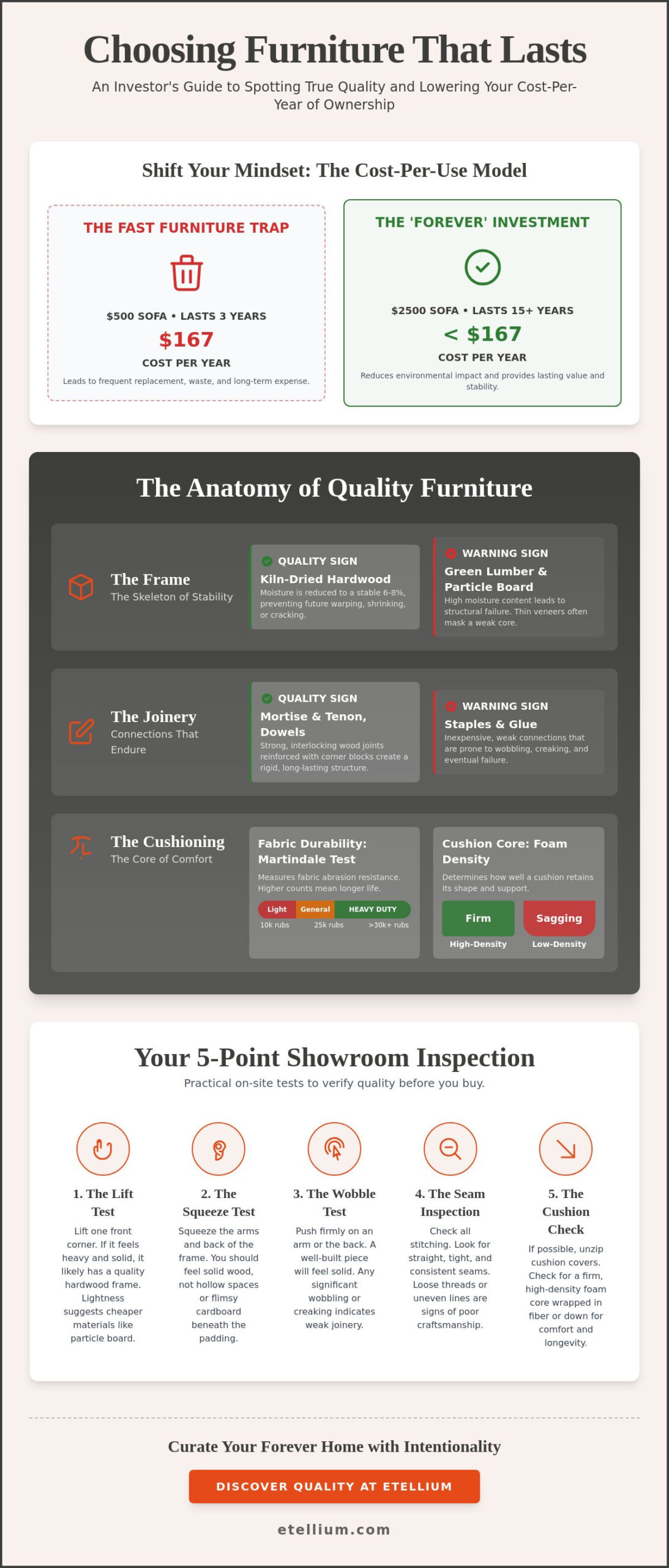
Luxury is frequently misunderstood as a purely visual attribute. In reality, the truest form of luxury is reliability. When you’re choosing furniture that lasts, you aren’t just buying a place to sit; you’re investing in a piece of your home’s history. This shift in perspective requires moving away from the initial price tag and toward a cost-per-use model. A well-crafted sofa might require a higher upfront investment, but when its lifespan spans decades rather than months, the annual cost is significantly lower than that of its disposable counterparts. You’re paying for the peace of mind that comes from knowing your environment won’t fail you.
Breaking the fast-furniture cycle is also an act of environmental stewardship. The global furniture market is projected to reach approximately $791 billion in 2025, and a large portion of that growth is driven by low-quality, short-lived items. By selecting pieces with superior structural standards, you reduce the demand for the mass-produced, resource-heavy manufacturing that fills landfills every few years. There’s a profound psychological benefit to this intentionality. Surrounding yourself with lasting objects creates a sense of stability and calm in your daily environment, allowing your home to feel like a curated sanctuary rather than a revolving door of temporary goods.
Modern minimalist design demands even higher levels of craftsmanship. Without ornate carvings or busy patterns to hide behind, every line must be precise and every joint must be secure. In this style, the quality of the material is the primary decoration. If the core is weak, the aesthetic fails immediately. Choosing furniture that lasts means looking past the surface to find the invisible architecture that supports your life.
The Fast Furniture Trap
Mass-market retailers often use clever marketing to mask structural weaknesses. You’ve likely seen “solid wood” labels that actually refer to thin veneers over particle board. These trendy designs are engineered for the showroom floor, not for the realities of a busy household. It’s a frustrating cycle. The true cost of this trap isn’t just the replacement price every three years; it’s the constant labor of researching, buying, and disposing of items that were never meant to endure. These pieces often rely on staples and glue rather than proper joinery, leading to the inevitable wobbles and sags that define “disposable” decor.
The Philosophy of Curated Intentionality
At Etellium, we view furniture as a bridge between high-quality production and your everyday needs. Our selection process focuses on “forever” utility. This means balancing timeless aesthetics with evolving lifestyle requirements. Our Modern Minimalist Sectional Sofa, for example, is designed with these rigorous standards in mind, ensuring the frame remains as sturdy as the day it arrived. A piece shouldn’t just survive physically; it should remain relevant to your taste as the years pass. Choosing furniture that lasts is about finding that perfect intersection of enduring materials and a design language that never feels dated.
The Foundation of Durability: Frames, Joinery, and Materials
True durability begins where the eye cannot see. While a beautiful finish draws you in, the internal structure dictates how long the piece will actually remain in your home. Choosing furniture that lasts requires a basic understanding of material science and traditional craftsmanship. A piece might look solid on the outside, but its lifespan is determined by the moisture content of its timber and the integrity of its connections.
Metal frames have gained popularity in modern seating for their sleek profiles and inherent strength. However, high-quality wood remains the gold standard for most home environments. The key isn’t just the species of wood, but how it’s treated. When we designed our Modern Minimalist Sectional Sofa, we prioritized a reinforced frame to ensure the silhouette stays sharp through years of use. This attention to the “skeleton” of the piece prevents the wobbles and creaks that often plague mass-produced items.
The Skeleton: Frame Construction
The moisture content of wood is the most critical factor in long-term stability. Green lumber contains significant water. As it dries in your climate-controlled home, it inevitably shrinks, warps, or cracks. Kiln-dried hardwoods are the solution. This process reduces moisture to a stable 6 to 8 percent, ensuring the frame stays straight for decades. You should also look for corner blocks. These are extra pieces of wood bolted or screwed into the corners of the frame. They maintain squareness and prevent the frame from racking under pressure.
Don’t dismiss engineered materials entirely. While particle board is a sign of “fast furniture,” high-grade furniture plywood is often more stable than solid wood. Its layers are glued with alternating grain directions, which resists the natural expansion and contraction that can cause solid wood to split. The goal is a frame that feels heavy and immovable when you give it a firm shake. A sturdy frame is the only way to avoid the sagging that makes furniture feel old before its time.
Joinery: The Art of Connection
How two pieces of wood meet tells you everything about a manufacturer’s dedication. Staples, nails, and glue are the hallmarks of temporary furniture. They’re fast to assemble but fail quickly under the stress of daily movement. Superior joinery relies on the wood itself for strength. Dovetail joints, characterized by interlocking “teeth,” are the gold standard for drawer construction because they’re nearly impossible to pull apart.
For larger frames, look for mortise-and-tenon joints. This involves a protruding “tenon” fitting perfectly into a carved “mortise” hole. When combined with high-quality wood veneers, which are actual slices of real timber, these construction methods create a piece that’s both beautiful and structurally sound. Avoid paper laminates. These are essentially photographs of wood grain glued to plastic; they’ll peel or chip long before the frame ever gives out.
Evaluating Upholstery and Finishes for High-Traffic Life
Once you’ve verified the integrity of the internal frame, your focus must shift to the surface. The upholstery is the most vulnerable part of any piece, as it bears the brunt of daily friction, spills, and sunlight. Choosing furniture that lasts involves looking beyond the initial softness of a fabric to understand its technical endurance. A beautiful textile that pills or thins within two years isn’t a luxury; it’s a maintenance burden that eventually leads to premature replacement.
The distinction between high-quality finishes and “fast furniture” alternatives often comes down to density and fiber origin. Whether you’re selecting a piece for a quiet study or a central living area, the tactile quality should be matched by measurable performance data. This ensures your home remains a sophisticated sanctuary without the constant worry of sagging cushions or frayed edges.
The Fabric Performance Metrics
The most reliable indicator of fabric longevity is the Martindale Rub Count. This test simulates natural wear by rubbing a standard abrasive material against the fabric until it breaks. For a standard household, a count of 20,000 rubs is the essential benchmark for durability. If you’re looking for true “forever” quality, aim for performance fabrics that exceed 50,000 rubs. These materials are engineered to resist pilling, which occurs when loose fibers migrate to the surface and form small balls. A tight, dense weave is your best defense against this common aesthetic failure.
Natural fibers like linen and wool offer unmatched breathability and a refined hand-feel, but they often benefit from a small percentage of synthetic reinforcement. This blend provides the best of both worlds: the sensory appeal of nature and the structural resilience of modern science. When it comes to leather, always look for top-grain or full-grain options. Avoid bonded leather at all costs. Bonded leather is essentially a scrap-metal equivalent of fabric; it’s made from ground-up leather bits glued to a backing and is notorious for peeling within 24 months.
Cushioning and Support Systems
The longevity of a sofa is often determined by its foam density, measured in pounds per cubic foot. Many consumers mistake thickness for quality, but a thick, low-density foam will flatten quickly. High-resiliency (HR) foam, which we utilize in our Modern Minimalist Sectional Sofa, is the industry standard for preventing sagging. It offers a “bounce-back” quality that maintains the piece’s sharp silhouette over time.
You can test this in the showroom with a simple “seat memory” check. Press your hand firmly into the cushion and release. A high-quality cushion should return to its original shape almost instantly. Beneath the foam, the spring system provides the necessary counter-pressure. While 8-way hand-tied springs are the traditional gold standard, modern sinuous springs (S-shaped wires) offer excellent durability in minimalist designs if they are made from heavy-gauge steel. The goal is a support system that feels firm yet responsive, ensuring the comfort of the piece matches its physical endurance.
The 5-Point Quality Inspection Checklist for Savvy Shoppers
Theoretical knowledge is a powerful tool, but practical application is where you truly protect your investment. When you’re on the showroom floor, you need a repeatable method to verify the claims made by sales representatives. Choosing furniture that lasts isn’t about luck. It’s about performing a series of deliberate tests that reveal the piece’s true nature. These five steps will help you move past the aesthetic surface and into the technical reality of the item’s construction.
- The Lift Test: Lift one front corner of a sofa or chair about six inches off the ground. The other front leg should also rise. If it stays on the floor or the frame twists, the joinery is weak.
- The Squeeze Test: Firmly grip the arms and back of upholstered pieces. You shouldn’t feel the hard edges of the frame. If you do, the padding is insufficient and the fabric will likely tear against the wood over time.
- The Level Test: On case goods like dressers, check that all doors and drawers align perfectly. Even a slight tilt suggests a frame that isn’t square.
- The Hardware Check: Open every drawer. High-quality pieces use metal glides and solid metal pulls rather than plastic-core components.
- The Odour Test: A strong, sharp chemical smell often indicates low-quality adhesives or finishes with high VOC levels, which can affect your home’s air quality.
Physical Stress Tests
Don’t be afraid to apply a little pressure. Lean on the corner of a table or push against the arm of a sofa. There should be zero “give” or creaking. If a piece wobbles under moderate stress now, it won’t survive five years of daily use. Test the drawer glides by opening them with a single finger. They should move silently and smoothly without sticking. While weight is often a sign of density, be careful. Some manufacturers use heavy but brittle medium-density fiberboard (MDF) to mimic the feel of solid wood. True quality is found in the balance of weight and structural rigidity.
Inspecting the Unseen
The underside of a piece tells the most honest story. Flip a chair over or look behind a cabinet. A quality manufacturer applies a consistent finish even to areas that aren’t visible. Look for unfinished surfaces that feel rough to the touch; these are breeding grounds for moisture absorption and warping. Check that the hardware is recessed and secured with screws, not just glue. If you’re looking for a piece that embodies these rigorous standards, explore our Modern Minimalist Sectional Sofa, which is built to pass every one of these technical inspections.
Curating Your Forever Home with Etellium’s Minimalist Standards
Creating a home that endures requires more than just a keen eye for style. It demands a commitment to the technical standards we’ve explored throughout this guide. At Etellium, we believe that luxury is a long-term relationship between an object and its owner. Choosing furniture that lasts is the first step in breaking the cycle of disposable consumption and moving toward a home defined by curated intentionality. We act as your knowledgeable guide, bridging the gap between high-quality manufacturing and the practical needs of your modern lifestyle.
You shouldn’t have to choose between speed and substance. We prioritize an efficient delivery process without ever compromising on our hand-selected quality. Each piece in our collection undergoes a rigorous vetting process to ensure it meets the structural benchmarks of “forever” furniture. By focusing on the invisible architecture of every item, we empower you to make decisions that look as good in ten years as they do the day they arrive. This dedication to high standards is what allows us to offer pieces that truly serve your home for decades.
The Etellium Selection Process
Our criteria for Luxury Home Decor are uncompromising. We look for the technical markers of excellence: kiln-dried hardwoods, high-density foam, and reinforced joinery. Our Modern Minimalist Sectional Sofa is the physical embodiment of these standards. It features a frame designed to resist warping and upholstery selected for its high Martindale rub count. When you pair our sectional with other thoughtfully selected items from our collection, you’re building an environment where every element is engineered for longevity. We focus on premium materials because we know that true minimalist beauty cannot exist without a foundation of strength.
Maintaining Your Investment
Longevity is a partnership. Once you’ve invested in quality, simple care routines can significantly extend the life of your furniture. Dust and grit are the primary enemies of upholstery, as they act like sandpaper on fabric fibers. Using our Portable High-Suction Car Vacuum is an excellent way to reach deep into the crevices of your sectional, removing abrasive particles before they cause wear. Additionally, the environment of your home plays a vital role. Wood and fabric are sensitive to pollutants and humidity. Integrating a Smart HEPA Air Purifier helps preserve these materials by maintaining a clean, stable atmosphere that prevents premature aging.
Designing a stress-free home is also a mental exercise. We recommend using resources like our Emotional Intelligence Mastery eBook to help you approach home curation with a sense of calm and purpose. A well-ordered, durable home supports your emotional well-being, reducing the friction of daily life. When you’re ready to move beyond temporary trends and invest in true craftsmanship, we are here to help. Explore our curated collection of lasting furniture and begin the journey of building a home that stands the test of time.
Building Your Home for the Years Ahead
Creating a sanctuary that endures requires looking past the surface of every piece. By mastering the technical markers of quality, from kiln-dried frames to rub-count metrics, you’ve moved from being a shopper to a sophisticated curator. Choosing furniture that lasts is no longer a matter of guesswork; it’s a deliberate decision to prioritize structural integrity and material density over temporary trends. You now have the tools to identify the invisible architecture that supports your daily life and ensures your investment remains a source of pride for decades.
At Etellium, we’re dedicated to helping you realize this vision of a lasting home. Our collection is meticulously hand-selected for its structural resilience and timeless aesthetic. We focus on high-rub-count fabrics and reinforced frames to ensure that our pieces withstand the realities of high-traffic living. When you’re ready to elevate your space, Invest in Quality with our Modern Minimalist Sectional Sofa. We combine this dedication to excellence with express delivery on luxury goods, so you don’t have to wait to begin your journey toward a more intentional home. Your home is your legacy. We’re here to help you build it with confidence and clarity.
Frequently Asked Questions
How can I tell if a sofa frame is made of solid wood or particle board?
You can identify the material by inspecting the weight and the grain pattern on unfinished surfaces. Particle board is significantly lighter than solid wood and is typically covered in a perfectly uniform paper or plastic laminate. Solid wood exhibits natural grain variations that continue through the entire thickness of the board. If the piece sounds hollow when tapped or feels suspiciously light for its size, it’s likely made of engineered scraps.
What is a good Martindale rub count for a family sofa?
A Martindale count of 20,000 rubs is the baseline for general domestic use. For a busy household with children or pets, you should prioritize fabrics with 30,000 to 50,000 rubs. This higher rating ensures the upholstery can withstand constant friction and movement without thinning or pilling. It’s a measurable way to verify that the textile is engineered for high-traffic endurance rather than just aesthetic appeal.
Is heavier furniture always higher quality than lighter pieces?
Weight is a helpful indicator of density, but it’s not an absolute guarantee of excellence. While a heavy frame often suggests the use of kiln-dried hardwoods, some manufacturers use medium-density fiberboard (MDF) to add artificial heft to low-quality items. You should focus on structural rigidity. A truly high-quality piece won’t twist, creak, or flex when you lift one corner or apply pressure to the armrests.
How long should a high-quality sectional sofa actually last?
A well-constructed sectional sofa should remain in your home for 15 to 25 years. Choosing furniture that lasts means investing in a piece where the internal frame and support system outlive the first round of upholstery. While you might choose to recover the fabric after a decade to refresh the look, the core architecture should stay as sturdy and silent as the day it was delivered.
What are the signs of poor quality joinery to look for in drawers?
Look for staples, nails, or visible globs of glue at the connection points. These are the hallmarks of temporary furniture designed for quick assembly rather than longevity. Quality drawers feature interlocking dovetail joints that stay secure even under the weight of heavy contents. If the drawer bottom feels thin or flexes easily when you press down on it, the piece likely lacks the structural integrity required for daily use.
Are synthetic fabrics more durable than natural fibers like cotton or linen?
Synthetic fibers like polyester and nylon generally offer superior resistance to abrasion, fading, and staining. Natural fibers provide a more sophisticated hand-feel and better breathability, but they can stretch or wear down faster in high-traffic areas. A blend is often the most practical choice for a modern home. It combines the sensory luxury of natural materials with the resilient, long-lasting structure of high-performance synthetic yarns.
Does “Minimalist” furniture mean it is less sturdy because it looks thinner?
Minimalist design actually demands higher engineering standards because the structural elements are often exposed. Choosing furniture that lasts in a minimalist style requires looking for premium materials like reinforced steel or high-density hardwoods. These materials provide the necessary strength without the need for bulky, heavy silhouettes. The “thin” look is a result of precision craftsmanship and material density, not a lack of stability or durability.
How do I know if the leather on a chair is genuine or bonded?
Genuine leather has an irregular grain and a distinct, earthy scent that cannot be perfectly replicated. Bonded leather is made from ground-up scraps glued to a backing; it often smells like chemicals or plastic and features a perfectly repeating surface pattern. If you can see a fabric mesh on the underside of a sample or if the surface feels cold and rubbery, it’s likely a bonded product that will peel quickly.









Leave a comment